
1、Equipment Overview
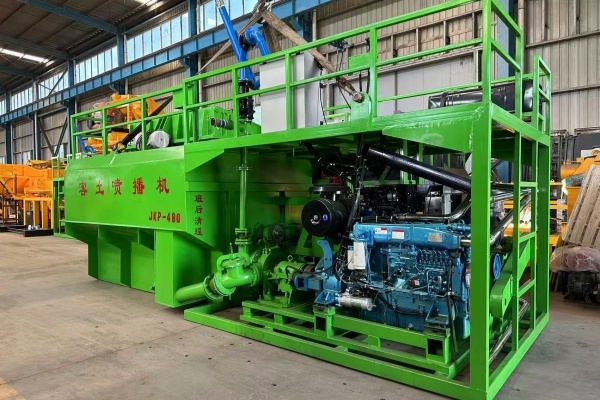
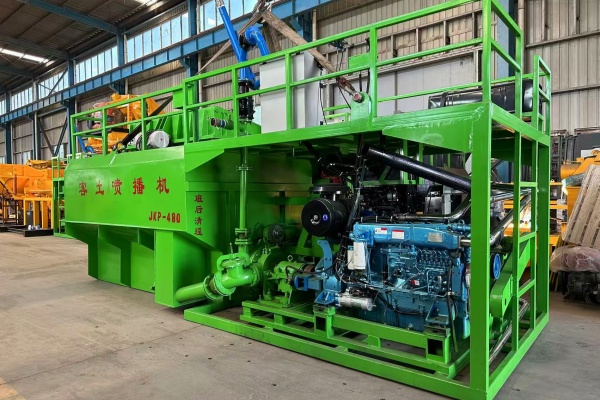
The JKP-480 Soil Hydroseeding Machine is a professional slope greening equipment with high horsepower and high lift, specially designed for large-scale ecological projects such as mine restoration, expressway slope protection and river bank revetment. It can mix soil, organic fertilizer, water-retaining agent, adhesive, grass seed and other materials with water into slurry, and spray the slurry onto the slope surface through a high-pressure pump to realize efficient vegetation restoration and slope protection.
2、 Core Technical Parameters (JKP-480 Custom Power)
· Tank: Nominal volume 8 m³, geometric volume 8200 L, working volume 8000 L
· Screen-free function: Equipped with screen-free function, with the vibrating screen opening on the side of the equipment
· Mixing system: Adopting a composite mode of mechanical chain variable speed mixing, horizontal shaft inclined paddle blade mixing and circulating jet mixing, capable of forward and reverse rotation; mixing power is 40 kW/55 HP (East China), and the rotating speed of the mixing shaft is adjustable from 10 to 100 r/min
· Slurry pump: Flow rate 90 m³/h, outlet pressure 1.6 MPa, adopting mechanical clutch direct drive mode; maximum solid content 70%, maximum particle size 20 mm
· Power system: Equipped with a custom special six-cylinder turbocharged water-cooled diesel engine (East China Diesel Engine), power 309 kW/420 HP, rated speed 2200 r/min
· Operation performance: Spray gun type includes fixed gun + hose gun (optional), enabling long-distance large-area coverage and extended precise operation; equipped with a high-pressure backflow device in the tank with a flow rate of 1000 L/min for cleaning and pressure relief; nozzle configuration: two round nozzles (30 mm and 40 mm caliber) and one fan-shaped nozzle; horizontal direct spraying range 80-90 m, horizontal conveying distance with hose 200-400 m, vertical lift with hose 90-180 m; single tank spraying area 320-210 ㎡ (spraying thickness 2-3 cm); single tank spraying time 8 mins (direct spraying)/18 mins (with hose); fuel cost for single tank operation 35 CNY
· Other parameters: Equipped with a fenced operating platform; total machine weight 6392 kg; overall dimensions (Length×Width×Height) 6100×2200×2500 mm; standard accessories include three nozzles (including one fan-shaped nozzle), diesel engine spare parts, slurry pump spare parts, tool box, grease gun, sealing rings, pull wires, etc. For other accessories, refer to the detailed accessory list.
3、 Main Structure
· Mixing tank: 8 m³ large-capacity tank for material storage and mixing, equipped with a side vibrating screen to realize the screen-free function
· Mixing system: Composite mixing structure of mechanical chain variable speed + horizontal shaft inclined paddle blade + circulating jet, capable of forward and reverse rotation to ensure uniform slurry without precipitation
· Power system: Custom six-cylinder turbocharged water-cooled diesel engine, providing strong power to adapt to the operation requirements of high lift and large flow
· Pumping system: High-pressure slurry pump adopting mechanical clutch direct drive, capable of conveying slurry with a solid content of 70% and maximum particle size of 20 mm
· Spraying system: Combined fixed gun + hose gun (optional) with round and fan-shaped nozzles for precise spraying in different scenarios; the high-pressure backflow device can be used for cleaning and pressure relief
· Frame and platform: Equipped with a fenced platform to ensure operation safety; the equipment has a compact overall structure for easy relocation.
4、Pre-Start Inspection
1. Check the liquid levels of diesel oil, engine oil, coolant and hydraulic oil to ensure the good working condition of the power system
2. Check that the transmission chain/belt is properly tensioned and all protective devices are intact without damage
3. Inspect that the pipelines are free of damage and leakage, and all joints are fastened without loosening
4. Check that the spray guns and valves switch flexibly, and the nozzles are not blocked
5. Ensure that the discharge port and pump body are free of caking and blockage, and the mixing blades are not stuck
6. Confirm that the operation site is flat, the equipment outriggers are stable, and the fenced platform is not loose
5、 Standard Operating Procedure
5.1 Water Filling
Close the discharge valve and backflow valve, and add water to the tank to 1/2-2/3 of the liquid level to provide a basis for subsequent mixing.
5.2 Start Mixing
· Start the engine, warm up at idle speed for 3-5 minutes, and conduct load operation only when the water temperature is ≥60℃
· Engage the mixing clutch, turn on the forward and reverse mixing, and adjust to medium speed operation
5.3 Feeding Sequence
Feed materials in the order of water → adhesive/water-retaining agent → soil/substrate → organic fertilizer → grass seed, keep mixing evenly throughout the process to avoid dry lumps and precipitation; adjust the slurry concentration according to operation requirements to ensure the spraying effect.
5.4 Spraying Operation
1. After the slurry is mixed evenly, close the backflow valve
2. Engage the spraying clutch, slowly increase the throttle to boost pressure, and observe the pressure gauge until it reaches about 1.6 MPa
3. Keep the spray gun at an angle of 30°-45° to the slope surface, move at a constant speed, and control the spraying thickness at 2-3 cm
4. Follow the principle of bottom-up and sectional construction to avoid missing spraying and slurry sagging; if the lift is insufficient, appropriately increase the throttle, and open the backflow valve to release pressure when the pressure is too high
5. For long-distance operation, a conveying hose can be connected to achieve large-area coverage with the horizontal conveying capacity of 200-400 m
5.5 Shutdown Sequence
· First turn off the spraying function and open the backflow valve to release pressure
· Then stop the mixing system
· Finally, let the engine run at idle speed for 2 minutes and then shut down
· Timely clean the tank, pump body, pipelines and spray guns with the high-pressure backflow device to remove residual slurry
6、Safety Operation Rules
· Operators must pass professional training and obtain qualification before taking up the post, and wear safety helmets, goggles, gloves and other protective equipment during operation
· No person is allowed to stand in front of the spray gun, and high-pressure spraying is strictly prohibited to direct at people to avoid personal injury
· Climbing the tank or putting hands into the tank is forbidden during operation to prevent being drawn into the mixing blades
· In case of pipeline blockage, the machine must be shut down to release pressure first, then disassemble and dredge; operation under pressure is strictly prohibited
· Operation is prohibited under severe conditions such as thunderstorms, strong winds (Level 6 and above) and steep slopes
· Maintenance and adjustment operations are strictly prohibited when the equipment is running to avoid mechanical injury
7、Daily Maintenance and Upkeep
Daily
· Thoroughly clean the tank, pump body, pipelines and spray guns to remove all residual slurry and prevent caking and blockage
· Check the oil level, liquid level, belt/chain tension and joint sealing condition, and handle abnormalities in a timely manner
· Clean the air filter and fuel filter, and drain the accumulated water in the oil-water separator
Weekly
· Lubricate the chains and transmission parts with butter for maintenance
· Check the wear condition of the mixing blades and fasten all connecting bolts
· Test the sensitivity of the pressure gauge and safety valve to ensure the effectiveness of safety devices
Monthly/200 Working Hours
· Replace the engine oil, diesel filter and oil filter
· Check the hydraulic oil level and quality, and replace the hydraulic oil and hydraulic filter if necessary
· Check the wear condition of the slurry pump seals and wearing parts, and replace them in a timely manner
8、Common Faults and Troubleshooting
1. No discharge/Low pressure
· Causes: Air in the pump, valves not opened, pipeline blockage, excessively high slurry concentration
· Troubleshooting: Open the exhaust valve to release air, open relevant valves, dredge pipelines, add water to adjust the slurry concentration
1. Weak mixing/Slow rotating speed
· Causes: Clutch slipping, over-loose chain, insufficient power output
· Troubleshooting: Adjust the clutch clearance, tension the transmission chain, check the engine working condition
1. Leakage
· Causes: Aging seals, loose joints
· Troubleshooting: Replace aging seals, fasten loose joints
1. Nozzle blockage
· Causes: Over-thick slurry, mixed with hard lumps and impurities
· Troubleshooting: After shutting down the machine to release pressure, disassemble the nozzle for cleaning
9、Transportation and Storage
· Empty the tank, retract the outriggers and fasten the equipment firmly before transportation to avoid shaking and collision
· Thoroughly clean the equipment, empty all accumulated water and fuel, and cover with a dust cover before long-term storage
· Store in a dry and ventilated indoor space or shed to avoid exposure to the sun and rain and prevent component rusting
10、 Notes
· It is strictly forbidden to operate with excessive concentration and particle size to prevent overload damage to the slurry pump
· All accumulated water must be drained after operation in winter to prevent freezing and cracking of pipelines and pump body
· Use adhesives and water-retaining agents in strict accordance with the specified ratio to ensure the adhesion and water-retaining effect of the spraying layer
· Non-professionals are not allowed to disassemble the power system, hydraulic system and core components
二、Operating Instructions for JPS-3 Flat Vibrating Soil Screener (Customizable)
1. Equipment Overview
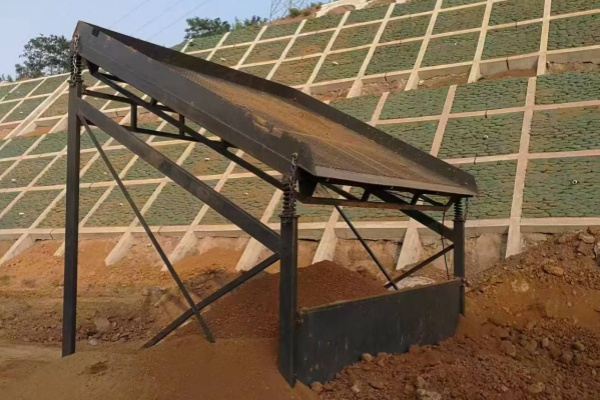
The JPS-3 Flat Vibrating Soil Screener is a small-scale screening equipment specially designed for scenarios such as slope greening, mine restoration and road construction. It can quickly screen soil, sand and gravel, organic fertilizer and other materials to remove large particle impurities, and provide qualified fine materials for subsequent processes such as hydroseeding and backfilling. The equipment has a compact structure, simple operation, and can be quickly disassembled and transported, suitable for on-site operation at various construction sites.
2.Core Technical Parameters (JPS-3)
· Model: JPS-3
· Overall dimensions: 3060 mm × 2600 mm × 3190 mm, stacking height after disassembly is 600 mm
· Total machine weight: 750 kg
· Screen mesh aperture: 15 mm × 15 mm
· Vibration motor power: 0.55 kW
· Motor voltage: 380 V
3. Main Structure
· Screen mesh platform: Adopting a metal screen mesh with 15 mm×15 mm aperture, installed on a spring-supported frame, and realizing material screening through vibration
· Vibration system: Equipped with a 0.55 kW vibration motor to drive the screen mesh to vibrate at high frequency, accelerating the falling of fine materials and separation of coarse materials
· Frame and outriggers: Steel structure frame with adjustable outriggers to ensure equipment stability; the overall design is convenient for disassembly and transportation
· Receiving hopper: A receiving hopper is arranged under the screen mesh to collect the screened fine materials, facilitating subsequent transportation or direct feeding into equipment such as soil hydroseeding machines
4. Pre-Start Inspection
1. Check whether the equipment is placed stably and the outriggers are firm to avoid shaking or tipping during operation
2. Check whether the screen mesh is intact without damage and blockage, and the edges of the screen mesh are fastened without loosening
3. Check whether the wiring of the vibration motor is firm, the insulating layer is free of damage, and the grounding protection is reliable
4. Check whether the power supply voltage is 380 V and the cable is free of aging and damage
5. Clean the residual materials in the screen mesh and receiving hopper to ensure no caking and blockage
5.Standard Operating Procedure
5.1 Equipment Positioning
Place the equipment on a flat and solid ground, adjust the outriggers to keep the equipment level and stable, and align the receiving hopper with the fine material stacking area or conveying equipment.
5.2 Start-Up
· Confirm that all personnel are away from the equipment and there are no sundries on the screen mesh
· Connect the 380 V power supply, start the vibration motor, and observe whether the screen mesh vibrates evenly and there is any abnormal noise
5.3 Feeding and Screening
· Use a loader or manual labor to evenly spread the materials to be screened on the screen mesh, avoiding overloading caused by feeding a large amount of materials at one time
· Fine materials fall into the receiving hopper through the screen mesh, and coarse materials (stones, large soil clods) stay on the surface of the screen mesh, which can be cleaned manually or slide to one side with vibration
· Control the feeding speed to maintain screening efficiency and avoid screen mesh blockage
5.4 Shutdown Sequence
· Stop feeding, and turn off the vibration motor after all materials on the screen mesh are completely screened
· Cut off the power supply and clean the residual materials in the screen mesh and receiving hopper
· If transportation is needed, the equipment can be disassembled according to the disassembly steps and transported after stacking (stacking height 600 mm)
6. Safety Operation Rules
· Operators must pass training and obtain qualification before taking up the post, and wear safety helmets and protective gloves during operation
· When the equipment is running, it is strictly forbidden to put hands and tools into the screen mesh or receiving hopper to avoid being drawn into the vibration parts
· Maintenance, adjustment or cleaning operations are strictly prohibited when the equipment is running
· Set up warning signs at the operation site to prevent irrelevant personnel from approaching
· Operation is prohibited in thunderstorms or humid environments to prevent electric shock
7. Daily Maintenance and Upkeep
Daily
· Clean the residual materials in the screen mesh and receiving hopper, and check whether the screen mesh is damaged or blocked
· Check whether the fixing bolts of the vibration motor are loose and the wiring is firm
· Check whether the spring supports are intact without fracture and deformation
Weekly
· Fill the bearings of the vibration motor with lubricating grease to keep the operation smooth
· Check all connecting bolts and fasten loose parts
· Clean the motor heat dissipation port to avoid dust accumulation affecting heat dissipation
Monthly/100 Working Hours
· Check the wear condition of the screen mesh and replace it if necessary
· Check the insulation performance of the motor to ensure safety and reliability
8. Common Faults and Troubleshooting
1. Low screening efficiency/Screen mesh blockage
· Causes: Excessive feeding, over-wet materials, blocked screen mesh aperture
· Troubleshooting: Reduce the feeding amount, air-dry the materials, clean the screen mesh
1. Weak vibration/Abnormal noise
· Causes: Motor failure, spring fracture, loose bolts
· Troubleshooting: Overhaul the motor, replace the spring, fasten the bolts
1. Motor overheating
· Causes: Poor heat dissipation, overload operation
· Troubleshooting: Clean the heat dissipation port, reduce the feeding amount, avoid long-term continuous operation
9. Transportation and Storage
· Disassemble the equipment, stack it and fasten it firmly before transportation to avoid shaking and collision
· Thoroughly clean the equipment, apply anti-rust oil and cover with a dust cover before long-term storage
· Store in a dry and ventilated place to avoid exposure to the sun and rain and prevent component rusting
10. Notes
· It is strictly forbidden to screen large materials exceeding the screen mesh aperture to avoid damage to the screen mesh and motor
· Keep the equipment level during operation to avoid uneven material accumulation caused by inclination
· Non-professionals are not allowed to disassemble the vibration motor or core components
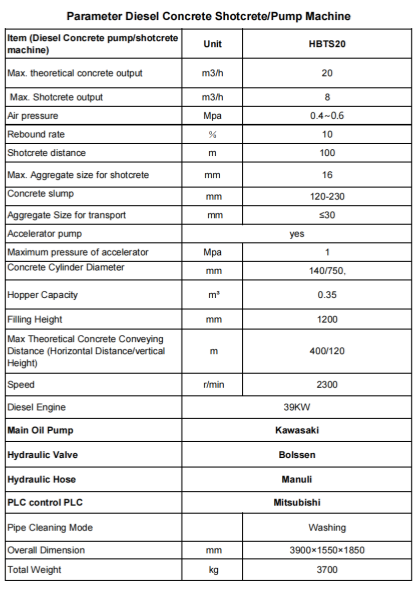
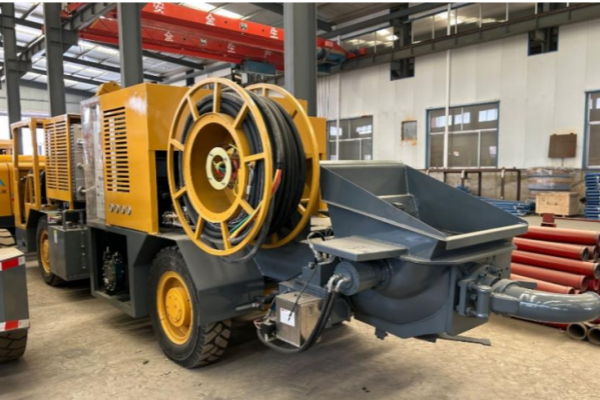
三、Parameter Diesel Concrete Shotcrete/Pump Machine
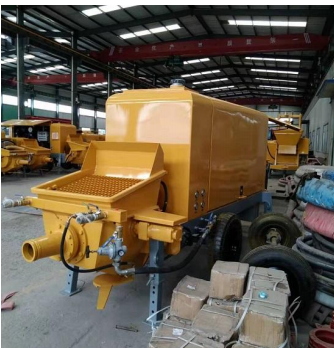
四、UPS-20ZT Diesel type wet concrete shotcrete robot machine
The UPS-20ZT diesel engine wet concrete spray truck designed and produced by Minle Machinery is an advanced, reliable and intelligent wet spray truck that combines the advantages of domestic and foreign products and is continuously upgraded and optimized. It has full functions, wide adaptability and stable performance. Reliable, large spraying capacity, high operating efficiency, good spraying effect, flexible and convenient control, and strong self-propelled ability. It is widely used in tunnels, culverts, subways, slopes and other projects.
Main technical features:
1. It adopts a special engineering off-road chassis, four-wheel drive, four-wheel wet braking, and four-wheel steering (four steering modes: oblique, centripetal, front wheel, and rear wheel). It has good maneuverability, small turning radius, and is suitable for narrow , complex underground road conditions. The cab has a wide view. The Italian Carraro wet brake axle is used, the traveling system adopts the static hydraulic system, and the closed traveling main pump and motor are used.
2. The manipulator has a large spray range, many degrees of freedom, flexible remote control operation, good spray flatness, less rebound, high spray efficiency, good construction quality, stable structure, safety and reliability, and smooth movement.
3. The quick-setting agent adding system adopts a hose pump, which has large flow rate, long life and good reliability. The proportion can be adjusted as needed, and the amount of admixture and concrete pump delivery volume can be monitored and adjusted in real time through the industrial control screen or remote control.
4. The electrical system is reliable and durable. Most of the components are imported famous brand products from home and abroad, and all spray operations can be centrally operated by one person on the remote control. It adopts wireless remote control, which is convenient and flexible. It comes standard with a hydraulic motor-driven cable reel for retracting and retracting cables.
5. It is driven by an electric motor during normal spray construction. In the event of a power outage, the power of the diesel engine can also be used to make the pumping system work for a short time and the injection manipulator to retract and release the manipulator at a slower speed.
6. Equipped with diesel exhaust gas treatment system。
| Previous:ADDFORCE LT3500 mobile self-loading concrete mixer | Next:ADDFORCE LT3500 mobile self-loading concrete mixer |